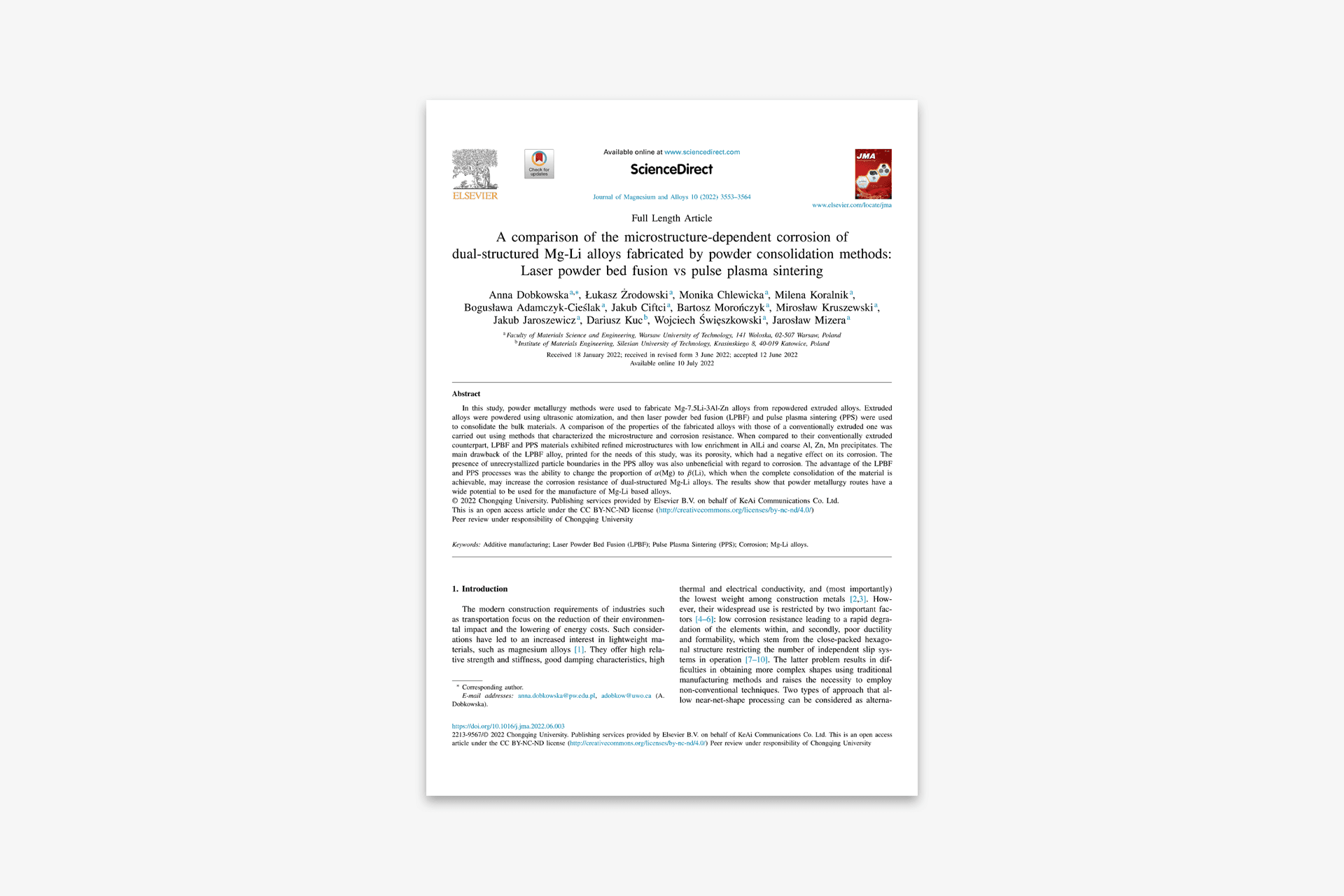
A comparison of the microstructure-dependent corrosion of dual-structured Mg-Li alloys fabricated by powder consolidation methods: Laser powder bed fusion vs pulse plasma sintering
Description & AMAZEMET association
Using AMAZEMET’s rePowder system, extruded Mg-7.5Li-3Al-1Zn alloys were transformed into high-quality powders via ultrasonic atomization, enabling advanced powder metallurgy processes. Laser Powder Bed Fusion (LPBF) and Pulse Plasma Sintering (PPS) were used to consolidate the powders, resulting in refined microstructures compared to conventionally extruded alloys, with improved control over α(Mg) to β(Li) phase proportions. While challenges like porosity in LPBF and boundary effects in PPS remain, these powder metallurgy routes highlight significant potential for tailoring corrosion resistance and performance in Mg-Li-based alloys for innovative applications.
Authors
Anna Dobkowska a, Łukasz Żrodowski a, Monika Chlewicka a, Milena Koralnik a, Bogusława Adamczyk-Cieślak a,
Jakub Ciftci a, Bartosz Morończyk a, Mirosław Kruszewski a, Jakub Jaroszewicz a, Dariusz Kuc b, Wojciech Święszkowski a, Jarosław Mizera a
a Faculty of Materials Science and Engineering, Warsaw University of Technology, 141 Woloska, 02-507 Warsaw, Poland
b Institute of Materials Engineering, Silesian University of Technology, Krasinskiego 8, 40-019 Katowice, Poland
Abstract
In this study, powder metallurgy methods were used to fabricate Mg-7.5Li-3Al-Zn alloys from repowdered extruded alloys. Extruded alloys were powdered using ultrasonic atomization, and then laser powder bed fusion (LPBF) and pulse plasma sintering (PPS) were used to consolidate the bulk materials. A comparison of the properties of the fabricated alloys with those of a conventionally extruded one was carried out using methods that characterized the microstructure and corrosion resistance. When compared to their conventionally extruded counterpart, LPBF and PPS materials exhibited refined microstructures with low enrichment in AlLi and coarse Al, Zn, Mn precipitates. The main drawback of the LPBF alloy, printed for the needs of this study, was its porosity, which had a negative effect on its corrosion. The presence of unrecrystallized particle boundaries in the PPS alloy was also unbeneficial with regard to corrosion. The advantage of the LPBF and PPS processes was the ability to change the proportion of α(Mg) to β(Li), which when the complete consolidation of the material is achievable, may increase the corrosion resistance of dual-structured Mg-Li alloys. The results show that powder metallurgy routes have a wide potential to be used for the manufacture of Mg-Li based alloys.
Share this content!