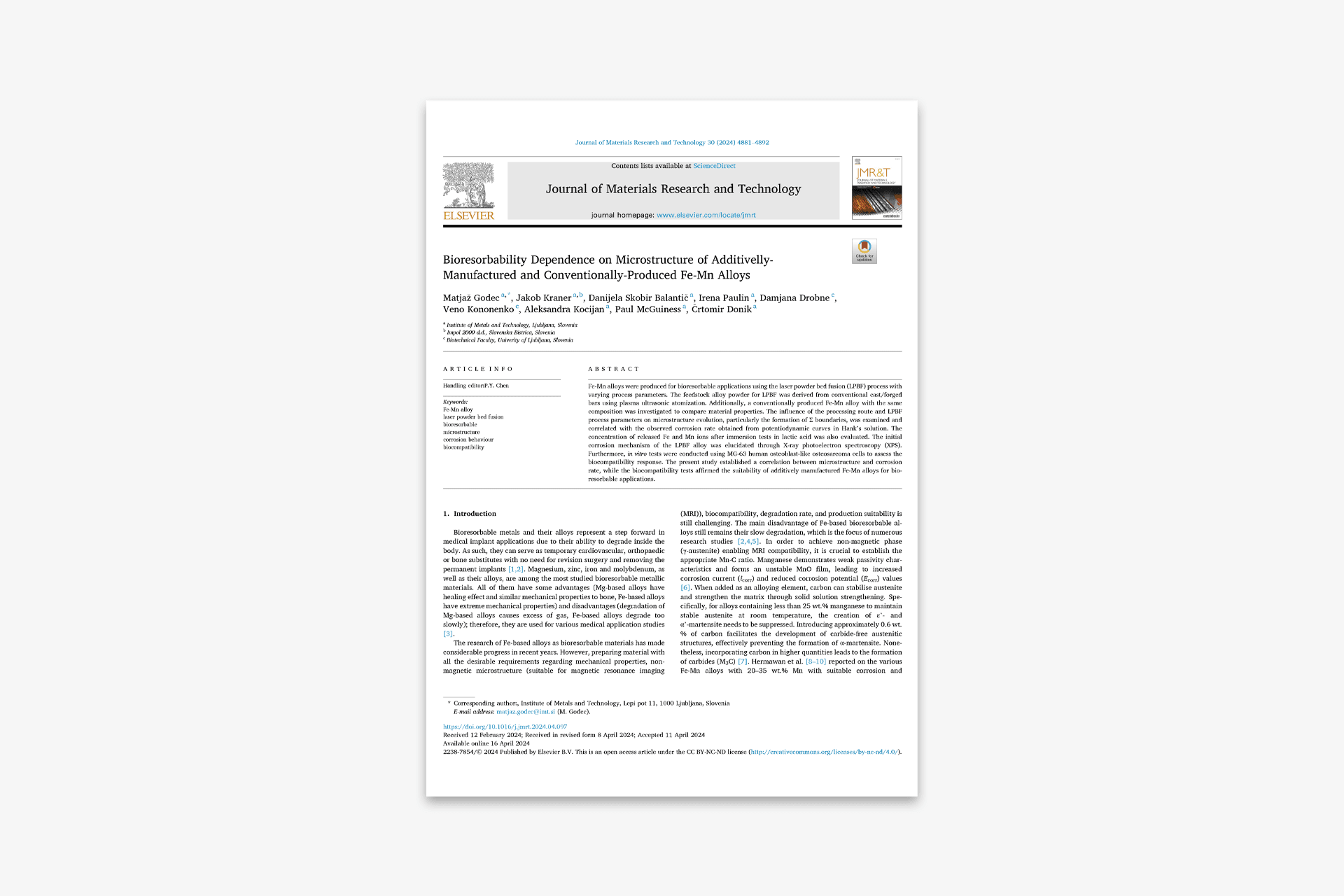
Bioresorbability Dependence on Microstructure of Additivelly- Manufactured and Conventionally-Produced Fe-Mn Alloys
Description & AMAZEMET association
Fe-Mn alloys for bioresorbable applications were fabricated using Laser Powder Bed Fusion (LPBF) from powders produced via plasma ultrasonic atomization with AMAZEMET’s rePowder system. Compared to conventionally manufactured alloys, LPBF-processed Fe-Mn exhibited tailored microstructures, including Σ boundaries, which significantly influenced the corrosion behavior in Hank’s solution and ion release rates in lactic acid. Biocompatibility tests using MG-63 osteoblast-like cells confirmed the suitability of these alloys, showcasing the potential of additively manufactured Fe-Mn materials for innovative biomedical applications.
Authors
Matjaž Godec a, Jakob Kraner a b, Danijela Skobir Balantič a, Irena Paulin a, Damjana Drobne c, Veno Kononenko c, Aleksandra Kocijan a, Paul McGuiness a, Črtomir Donik a
a Institute of Metals and Technology, Ljubljana, Slovenia
b Impol 2000 d.d., Slovenska Bistrica, Slovenia
c Biotechnical Faculty, Univerity of Ljubljana, Slovenia
Abstract
Fe-Mn alloys were produced for bioresorbable applications using the laser powder bed fusion (LPBF) process with varying process parameters. The feedstock alloy powder for LPBF was derived from conventional cast/forged bars using plasma ultrasonic atomization. Additionally, a conventionally produced Fe-Mn alloy with the same composition was investigated to compare material properties. The influence of the processing route and LPBF process parameters on microstructure evolution, particularly the formation of Σ boundaries, was examined and correlated with the observed corrosion rate obtained from potentiodynamic curves in Hank’s solution. The concentration of released Fe and Mn ions after immersion tests in lactic acid was also evaluated. The initial corrosion mechanism of the LPBF alloy was elucidated through X-ray photoelectron spectroscopy (XPS). Furthermore, in vitro tests were conducted using MG-63 human osteoblast-like osteosarcoma cells to assess the biocompatibility response. The present study established a correlation between microstructure and corrosion rate, while the biocompatibility tests affirmed the suitability of additively manufactured Fe-Mn alloys for bioresorbable applications.
Share this content!