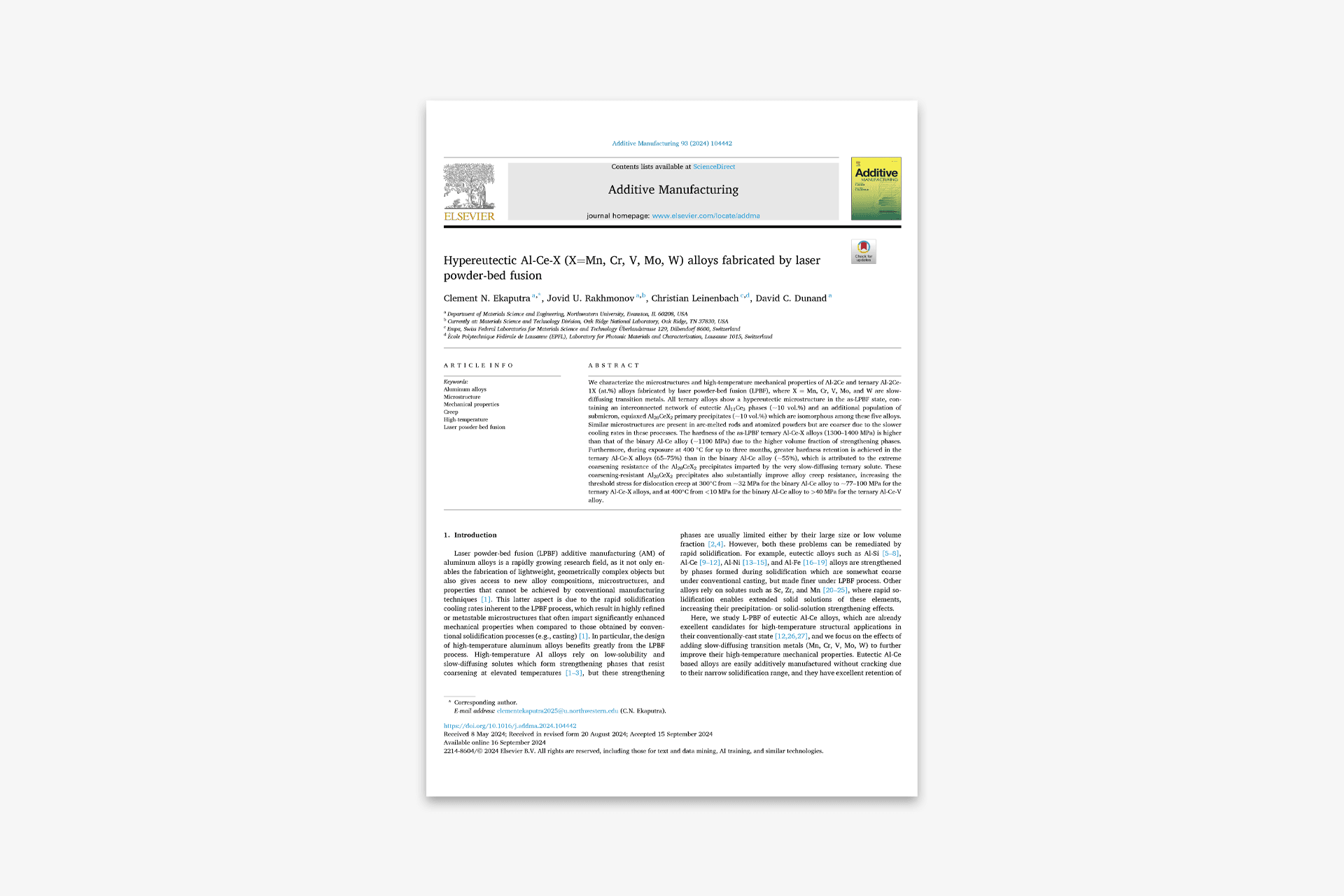
Hypereutectic Al-Ce-X (X=Mn, Cr, V, Mo, W) alloys fabricated by laser powder-bed fusion
Description & AMAZEMET association
High-performance Al-Ce-X (X = Mn, Cr, V, Mo, W) alloys have been developed using AMAZEMET’s rePowder induction atomization system to produce high-quality powders, enabling fabrication via Laser Powder-Bed Fusion (LPBF). These ternary alloys exhibit a hypereutectic microstructure with Al11Ce3 phases and coarsening-resistant Al20CeX2 precipitates, resulting in superior hardness (1300–1400 MPa) and excellent mechanical stability during prolonged exposure at 400 °C. Compared to binary Al-Ce alloys, the Al-Ce-X alloys demonstrate significantly enhanced creep resistance, maintaining higher threshold stresses at elevated temperatures, positioning them as a breakthrough in high-temperature structural materials.
Authors
Clement N. Ekaputra a, Jovid U. Rakhmonov a b , Christian Leinenbach c d, David C. Dunand a
a Department of Materials Science and Engineering, Northwestern University, Evanston, IL 60208, USA
b Currently at: Materials Science and Technology Division, Oak Ridge National Laboratory, Oak Ridge, TN 37830, USA
c Empa, Swiss Federal Laboratories for Materials Science and Technology Überlandstrasse 129, Dübendorf 8600, Switzerland
d École Polytechnique Fédérale de Lausanne (EPFL), Laboratory for Photonic Materials and Characterization, Lausanne 1015, Switzerland
Abstract
We characterize the microstructures and high-temperature mechanical properties of Al-2Ce and ternary Al-2Ce-1X (at.%) alloys fabricated by laser powder-bed fusion (LPBF), where X = Mn, Cr, V, Mo, and W are slow-diffusing transition metals. All ternary alloys show a hypereutectic microstructure in the as-LPBF state, containing an interconnected network of eutectic Al11Ce3 phases (∼10 vol.%) and an additional population of submicron, equiaxed Al20CeX2 primary precipitates (∼10 vol.%) which are isomorphous among these five alloys. Similar microstructures are present in arc-melted rods and atomized powders but are coarser due to the slower cooling rates in these processes. The hardness of the as-LPBF ternary Al-Ce-X alloys (1300–1400 MPa) is higher than that of the binary Al-Ce alloy (∼1100 MPa) due to the higher volume fraction of strengthening phases. Furthermore, during exposure at 400 °C for up to three months, greater hardness retention is achieved in the ternary Al-Ce-X alloys (65–75%) than in the binary Al-Ce alloy (∼55%), which is attributed to the extreme coarsening resistance of the Al20CeX2 precipitates imparted by the very slow-diffusing ternary solute. These coarsening-resistant Al20CeX2 precipitates also substantially improve alloy creep resistance, increasing the threshold stress for dislocation creep at 300°C from ∼32 MPa for the binary Al-Ce alloy to ∼77–100 MPa for the ternary Al-Ce-X alloys, and at 400°C from <10 MPa for the binary Al-Ce alloy to >40 MPa for the ternary Al-Ce-V alloy.
Share this content!