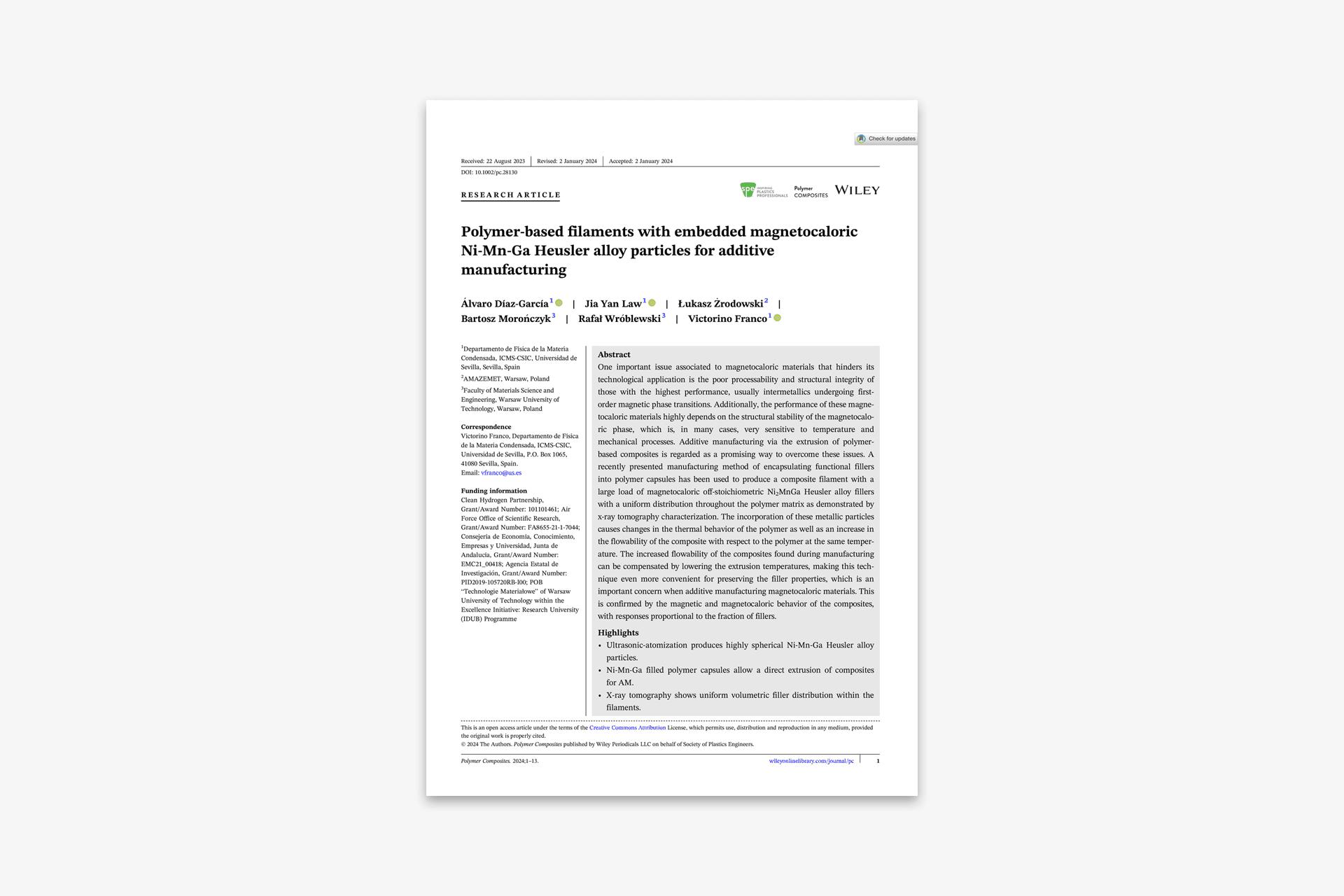
Polymer-based filaments with embedded magnetocaloric Ni-Mn-Ga Heusler alloy particles for additive manufacturing

Description & AMAZEMET association

To address processability challenges in high-performance magnetocaloric materials, a novel method combines ultrasonic atomization and polymer encapsulation. Off-stoichiometric Ni₂MnGa Heusler alloy powders, produced by AMAZEMET and the Warsaw University of Technology via ultrasonic atomization at 20 kHz, yielded spherical particles optimized for additive manufacturing. These powders, uniformly distributed in polymer filaments, preserved their magnetocaloric properties while enhancing flowability and enabling precise thermal and structural control, paving the way for innovative applications in magnetocaloric technologies.

Authors

Álvaro Díaz-García 1, Jia Yan Law 1, Łukasz Żrodowski 2, Bartosz Morończyk 3, Rafał Wróblewski 3, Victorino Franco 1*

1 Departamento de Física de la Materia Condensada, ICMS-CSIC, Universidad de Sevilla, Sevilla, Spain
2 AMAZEMET Sp. z o.o. [Ltd], Al. Jana Pawła II 27, 00-867 Warsaw, Poland
3 Faculty of Materials Science and Engineering, Warsaw University of Technology, Warsaw, Poland

* Correspondence Email: vfranco@us.es

Abstract

One important issue associated to magnetocaloric materials that hinders its technological application is the poor processability and structural integrity of those with the highest performance, usually intermetallics undergoing first-order magnetic phase transitions. Additionally, the performance of these magnetocaloric materials highly depends on the structural stability of the magnetocaloric phase, which is, in many cases, very sensitive to temperature and mechanical processes. Additive manufacturing via the extrusion of polymer-based composites is regarded as a promising way to overcome these issues. A recently presented manufacturing method of encapsulating functional fillers into polymer capsules has been used to produce a composite filament with a large load of magnetocaloric off-stoichiometric Ni2MnGa Heusler alloy fillers with a uniform distribution throughout the polymer matrix as demonstrated by x-ray tomography characterization. The incorporation of these metallic particles causes changes in the thermal behavior of the polymer as well as an increase in the flowability of the composite with respect to the polymer at the same temperature. The increased flowability of the composites found during manufacturing can be compensated by lowering the extrusion temperatures, making this technique even more convenient for preserving the filler properties, which is an important concern when additive manufacturing magnetocaloric materials. This is confirmed by the magnetic and magnetocaloric behavior of the composites, with responses proportional to the fraction of fillers.

Highlights

  • Ultrasonic-atomization produces highly spherical Ni-Mn-Ga Heusler alloy particles.
  • Ni-Mn-Ga filled polymer capsules allow a direct extrusion of composites for AM.
  • X-ray tomography shows uniform volumetric filler distribution within the filaments.
  • Decreased viscosity of the matrix favors the lowering of the processing temperature.
  • The low processing temperatures avoid altering the MCE of the alloy fillers.
Share this content!

About the Author: Jakub Tomaszewski

Change agent and problem solver in the field of marketing, working with mission-driven businesses. Helping AMAZAMET Team to deliver the right message to the right person, at just the right time. Constantly working to build a better tomorrow through marketing. Passionate photographer and videographer. Privately loving husband and father.

Check out related posts