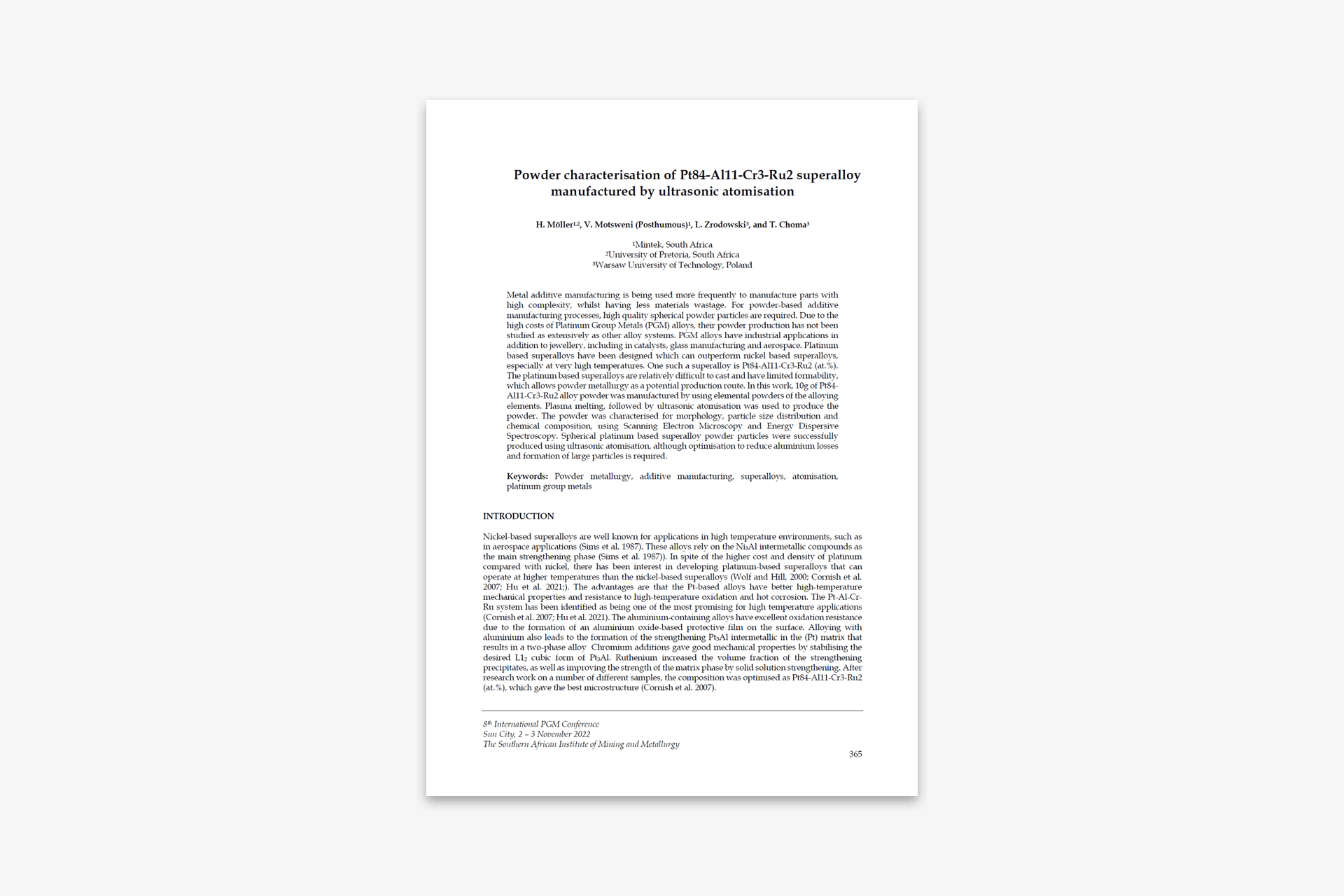
Powder characterisation of Pt84-Al11-Cr3-Ru2 superalloy manufactured by ultrasonic atomisation
Description & AMAZEMET association
This work shows that with use of AMAZEMET rePowder it is clearly possible to produce spherical metal powders for additive manufacturing from compacted elemental powders with even as low as ten grams of feedstock.
Authors
Heinrich Möller 1 2, V. Mostweni 1, Łukasz Zrodowski 3, Tomasz Choma 3
1 Mintek, South Africa
2 University of Pretoria, South Africa
3 Warsaw University of Technology, Poland
Abstract
Metal additive manufacturing is being used more frequently to manufacture parts with high complexity, whilst having less materials wastage. For powder-based additive manufacturing processes, high quality spherical powder particles are required. Due to the high costs of Platinum Group Metals (PGM) alloys, their powder production has not been studied as extensively as other alloy systems. PGM alloys have industrial applications in addition to jewellery, including in catalysts, glass manufacturing and aerospace. Platinum based superalloys have been designed which can outperform nickel based superalloys, especially at very high temperatures. One such a superalloy is Pt84-Al11-Cr3-Ru2 (at.%). The platinum based superalloys are relatively difficult to cast and have limited formability, which allows powder metallurgy as a potential production route. In this work, 10g of Pt84-Al11-Cr3-Ru2 alloy powder was manufactured by using elemental powders of the alloying elements. Plasma melting, followed by ultrasonic atomisation was used to produce the powder. The powder was characterised for morphology, particle size distribution and chemical composition, using Scanning Electron Microscopy and Energy Dispersive Spectroscopy. Spherical platinum based superalloy powder particles were successfully produced using ultrasonic atomisation, although optimisation to reduce aluminium losses and formation of large particles is required.
Share this content!