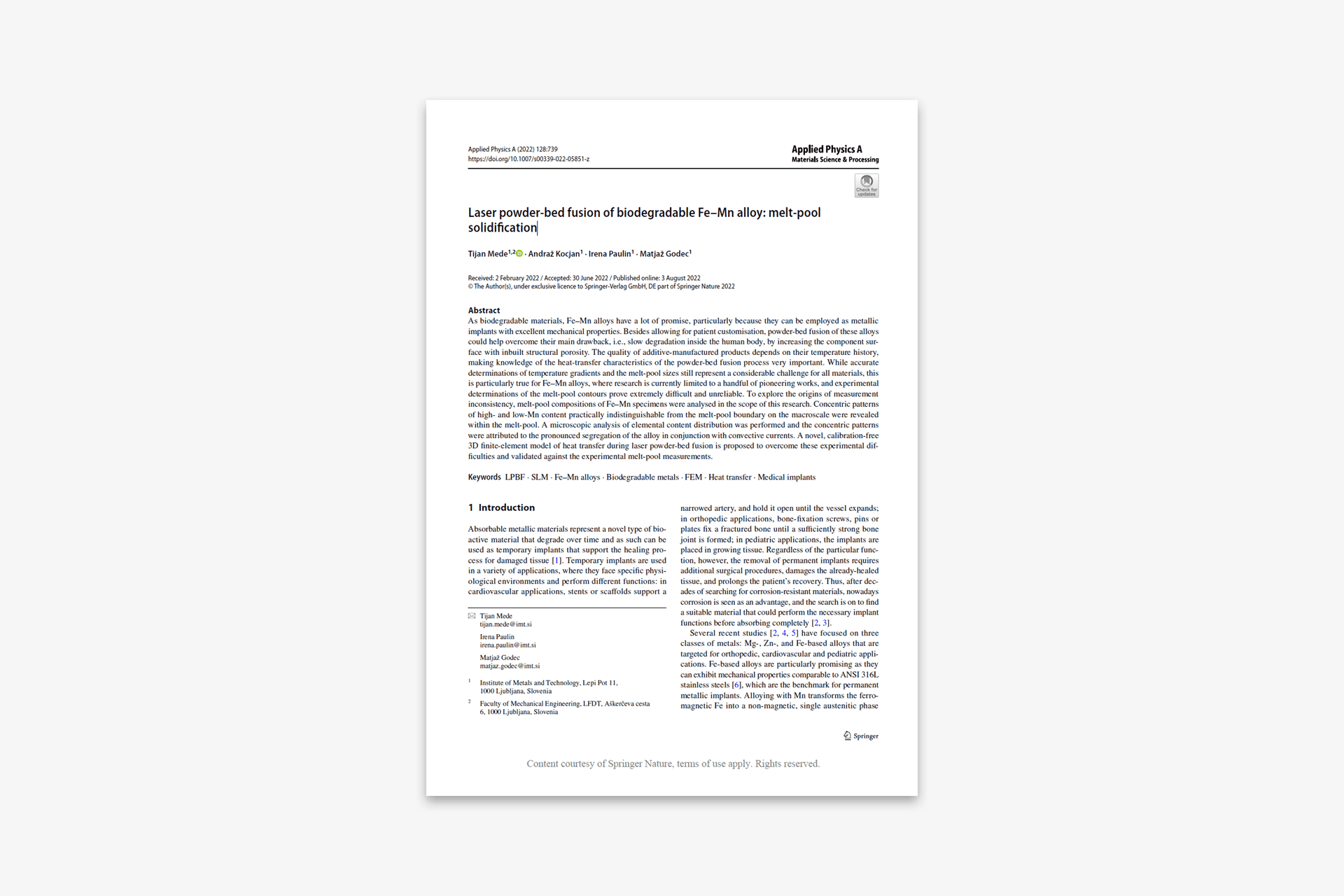
Laser powder-bed fusion of biodegradable Fe–Mn alloy: melt-pool solidification
Description & AMAZEMET association
Fe-Mn alloys hold immense potential as biodegradable materials for metallic implants, offering excellent mechanical properties and the possibility of customization through additive manufacturing. Powders produced using AMAZEMET’s ultrasonic technology, supported by plasma, exhibit spherical particles with precise chemical composition and uniformity, ensuring reliability in Laser Powder Bed Fusion (LPBF). To address challenges in understanding heat transfer during LPBF, a novel calibration-free 3D finite-element model was developed, uncovering concentric patterns of Mn segregation within the melt pool, advancing the understanding of Fe-Mn alloy processing for enhanced biomedical applications.
Authors
Tijan Mede a, Andraž Kocjan a, Irena Paulin a, Matjaž Godec a
a Institute of Metals and Technology
Abstract
As biodegradable materials, Fe–Mn alloys have a lot of promise, particularly because they can be employed as metallic implants with excellent mechanical properties. Besides allowing for patient customisation, powder-bed fusion of these alloys could help overcome their main drawback, i.e., slow degradation inside the human body, by increasing the component surface with inbuilt structural porosity. The quality of additive-manufactured products depends on their temperature history, making knowledge of the heat-transfer characteristics of the powder-bed fusion process very important. While accurate determinations of temperature gradients and the melt-pool sizes still represent a considerable challenge for all materials, this is particularly true for Fe–Mn alloys, where research is currently limited to a handful of pioneering works, and experimental determinations of the melt-pool contours prove extremely difficult and unreliable. To explore the origins of measurement inconsistency, melt-pool compositions of Fe–Mn specimens were analysed in the scope of this research. Concentric patterns of high- and low-Mn content practically indistinguishable from the melt-pool boundary on the macroscale were revealed within the melt-pool. A microscopic analysis of elemental content distribution was performed and the concentric patterns were attributed to the pronounced segregation of the alloy in conjunction with convective currents. A novel, calibration-free 3D finite-element model of heat transfer during laser powder-bed fusion is proposed to overcome these experimental difficulties and validated against the experimental melt-pool measurements.
Share this content!