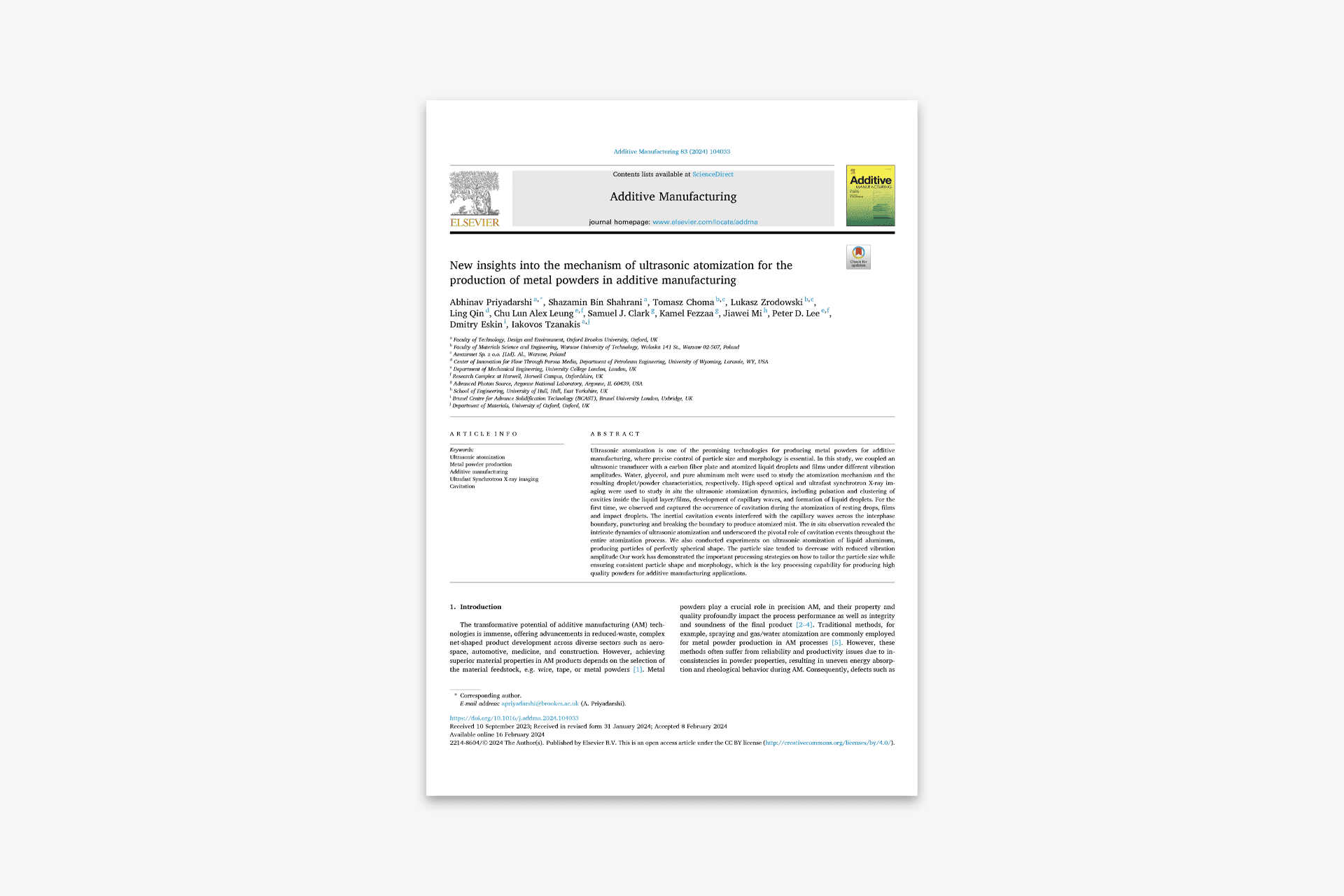
New insights into the mechanism of ultrasonic atomization for the production of metal powders in additive manufacturing
Description & AMAZEMET association
Ultrasonic atomization emerges as a transformative technology for producing metal powders tailored for additive manufacturing, where precise control over particle size and morphology is paramount. This study explored the dynamics of ultrasonic atomization using an ultrasonic transducer coupled with a carbon fiber plate, atomizing water, glycerol, and pure aluminum melt under varying vibration amplitudes. Using high-speed optical and ultrafast synchrotron X-ray imaging, the intricate dynamics of cavitation, capillary waves, and droplet formation were captured in situ, revealing the pivotal role of cavitation events in puncturing liquid boundaries to produce atomized mist.
Authors
Abhinav Priyadarshi a, Shazamin Bin Shahrani a, Tomasz Choma b c, Lukasz Zrodowski b c, Ling Qin d, Chu Lun Alex Leung e f, Samuel J. Clark g, Kamel Fezzaa g, Jiawei Mi h, Peter D. Lee e f, Dmitry Eskin i, Iakovos Tzanakis a j
a Faculty of Technology, Design and Environment, Oxford Brookes University, Oxford, UK
b Faculty of Materials Science and Engineering, Warsaw University of Technology, Woloska 141 St., Warsaw 02-507, Poland
c Amazemet Sp. z o.o. [Ltd]. Al., Warsaw, Poland
d Center of Innovation for Flow Through Porous Media, Department of Petroleum Engineering, University of Wyoming, Laramie, WY, USA
e Department of Mechanical Engineering, University College London, London, UK
f Research Complex at Harwell, Harwell Campus, Oxfordshire, UK
g Advanced Photon Source, Argonne National Laboratory, Argonne, IL 60439, USA
h School of Engineering, University of Hull, Hull, East Yorkshire, UK
i Brunel Centre for Advance Solidification Technology (BCAST), Brunel University London, Uxbridge, UK
j Department of Materials, University of Oxford, Oxford, UK
Abstract
Ultrasonic atomization is one of the promising technologies for producing metal powders for additive manufacturing, where precise control of particle size and morphology is essential. In this study, we coupled an ultrasonic transducer with a carbon fiber plate and atomized liquid droplets and films under different vibration amplitudes. Water, glycerol, and pure aluminum melt were used to study the atomization mechanism and the resulting droplet/powder characteristics, respectively. High-speed optical and ultrafast synchrotron X-ray imaging were used to study in situ the ultrasonic atomization dynamics, including pulsation and clustering of cavities inside the liquid layer/films, development of capillary waves, and formation of liquid droplets. For the first time, we observed and captured the occurrence of cavitation during the atomization of resting drops, films and impact droplets. The inertial cavitation events interfered with the capillary waves across the interphase boundary, puncturing and breaking the boundary to produce atomized mist. The in situ observation revealed the intricate dynamics of ultrasonic atomization and underscored the pivotal role of cavitation events throughout the entire atomization process. We also conducted experiments on ultrasonic atomization of liquid aluminum, producing particles of perfectly spherical shape. The particle size tended to decrease with reduced vibration amplitude Our work has demonstrated the important processing strategies on how to tailor the particle size while ensuring consistent particle shape and morphology, which is the key processing capability for producing high quality powders for additive manufacturing applications.
Share this content!