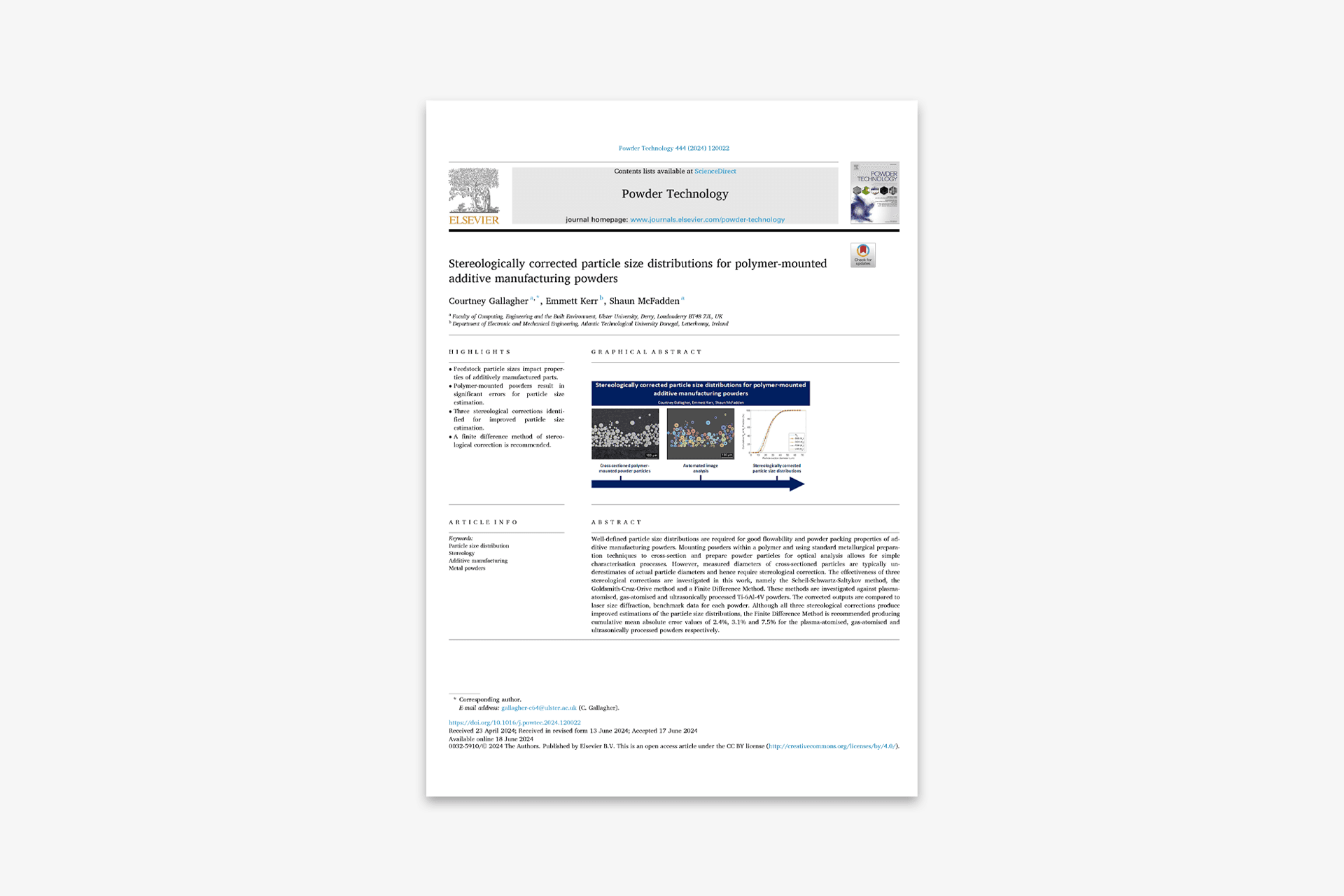
Stereologically corrected particle size distributions for polymer-mounted additive manufacturing powders
Description & AMAZEMET association
Ultrasonic atomization is revolutionizing powder production, delivering Ti-6Al-4V (Ti64) with superior particle size distribution for enhanced flowability and packing properties in additive manufacturing. In this paper, three stereological correction methods were compared, showing that ultrasonically processed Ti64 powders achieved remarkable precision with minimal error rates. These findings highlight ultrasonic atomization as a versatile, cost-effective technology poised to advance the quality of AM powders.
Authors
Courtney Gallagher a*, Emmett Kerr b, Shaun McFadden a
a Faculty of Computing, Engineering and the Built Environment, Ulster University, Derry/Londonderry, BT48 7JL, UK
b Department of Electronic and Mechanical Engineering, Atlantic Technological University Donegal, Letterkenny, Ireland
*Corresponding Author. Email: gallagher-c64@ulster.ac.uk
Abstract
Well-defined particle size distributions are required for good flowability and powder packing properties of additive manufacturing powders. Mounting powders within a polymer and using standard metallurgical preparation techniques to cross-section and prepare powder particles for optical analysis allows for simple characterisation processes. However, measured diameters of cross-sectioned particles are typically underestimates of actual particle diameters and hence require stereological correction. The effectiveness of three stereological corrections are investigated in this work, namely the Scheil-Schwartz-Saltykov method, the Goldsmith-Cruz-Orive method and a Finite Difference Method. These methods are investigated against plasma-atomised, gas-atomised and ultrasonically processed Ti-6Al-4V powders. The corrected outputs are compared to laser size diffraction, benchmark data for each powder. Although all three stereological corrections produce improved estimations of the particle size distributions, the Finite Difference Method is recommended producing cumulative mean absolute error values of 2.4%, 3.1% and 7.5% for the plasma-atomised, gas-atomised and ultrasonically processed powders respectively.
Keywords
Particle size distribution; Stereology; Additive manufacturing, Metal powders
Share this content!