Cobalt is a transition metal used in some of the most demanding areas of modern technology. Its value comes from a combination of high-temperature stability, corrosion resistance, magnetic behavior, wear resistance and the ability to improve the performance of alloys and chemical compounds.
Today, cobalt is often associated with lithium-ion batteries. However, cobalt uses extend far beyond energy storage. It is also used in superalloys, catalysts, magnets, pigments, wear-resistant materials, medical alloys and powder-based additive manufacturing.
In engineering, cobalt isn’t used because it’s cheap or easy to find, it’s actually quite expensive and scarce. Instead, it is chosen because it delivers reliable performance where other materials fail.
So, what are the main uses of cobalt, and why does this element remain relevant in advanced materials science?
Cobalt properties and uses: a scientific foundation
To understand cobalt properties and uses, it is necessary to examine its key characteristics:
- high melting point of approximately 1495°C
- strong resistance to oxidation and corrosion
- ferromagnetic behavior
- good wear resistance
- ability to stabilize alloy microstructures
These features make cobalt particularly valuable in environments where materials must withstand high temperatures, mechanical stress, and chemically aggressive conditions over long periods.
Cobalt uses in batteries and energy storage
One of the most widely recognized uses of cobalt is in lithium-ion batteries. In this context, cobalt is typically used in compound form, for example, in lithium cobalt oxide or nickel-manganese-cobalt systems.
Its primary function is to stabilize the crystal structure of the cathode, which directly affects energy density, cycle life and safety. This is why cobalt remains a key component in batteries used in electric vehicles, portable electronics and energy storage systems.
Although this application is primarily based on chemical compounds rather than metallic cobalt, powder processing is still relevant at earlier stages. Cathode materials are often synthesized and processed in finely divided form, where particle size and morphology influence electrochemical performance.
Cobalt element uses in superalloys and high-temperature systems
A major category of cobalt element uses involves high-performance alloys designed for extreme conditions. Cobalt-based and cobalt-containing superalloys are used in aerospace and energy industries, particularly in jet engines and gas turbines.
In these systems, cobalt contributes to creep resistance, thermal stability and resistance to oxidation. It helps maintain microstructural integrity during long-term exposure to high temperatures and mechanical loads.
Typical applications include:
- turbine components
- combustion system elements
- high-temperature structural parts
In contrast to battery applications, cobalt here acts as a structural material. Its role is directly linked to mechanical reliability and long service life.
Cobalt uses in everyday life
There are also several cobalt uses in everyday life, although they are often less visible.
Cobalt compounds are widely used as pigments, especially in ceramics and glass. The characteristic cobalt blue color has been used for centuries and remains relevant in modern materials.
In addition, cobalt is used in magnets and wear-resistant materials found in tools and mechanical systems. These applications rely on their magnetic properties and resistance to degradation.
Cobalt in catalysis and chemical processing
Another important group of uses of cobalt involves catalysis. Cobalt is used in industrial processes such as Fischer–Tropsch synthesis and hydrogenation reactions.
In these applications, catalytic efficiency depends strongly on surface properties. This is why cobalt is often used in finely dispersed form, where increased surface area improves reaction performance.
Although this is not always described as powder metallurgy, the underlying principle is similar. Controlling particle size and distribution is essential for achieving the desired functionality.
Cobalt powder and additive manufacturing
The most direct connection between cobalt and advanced manufacturing appears in powder-based technologies. This is where cobalt plays a significant role in modern engineering workflows.
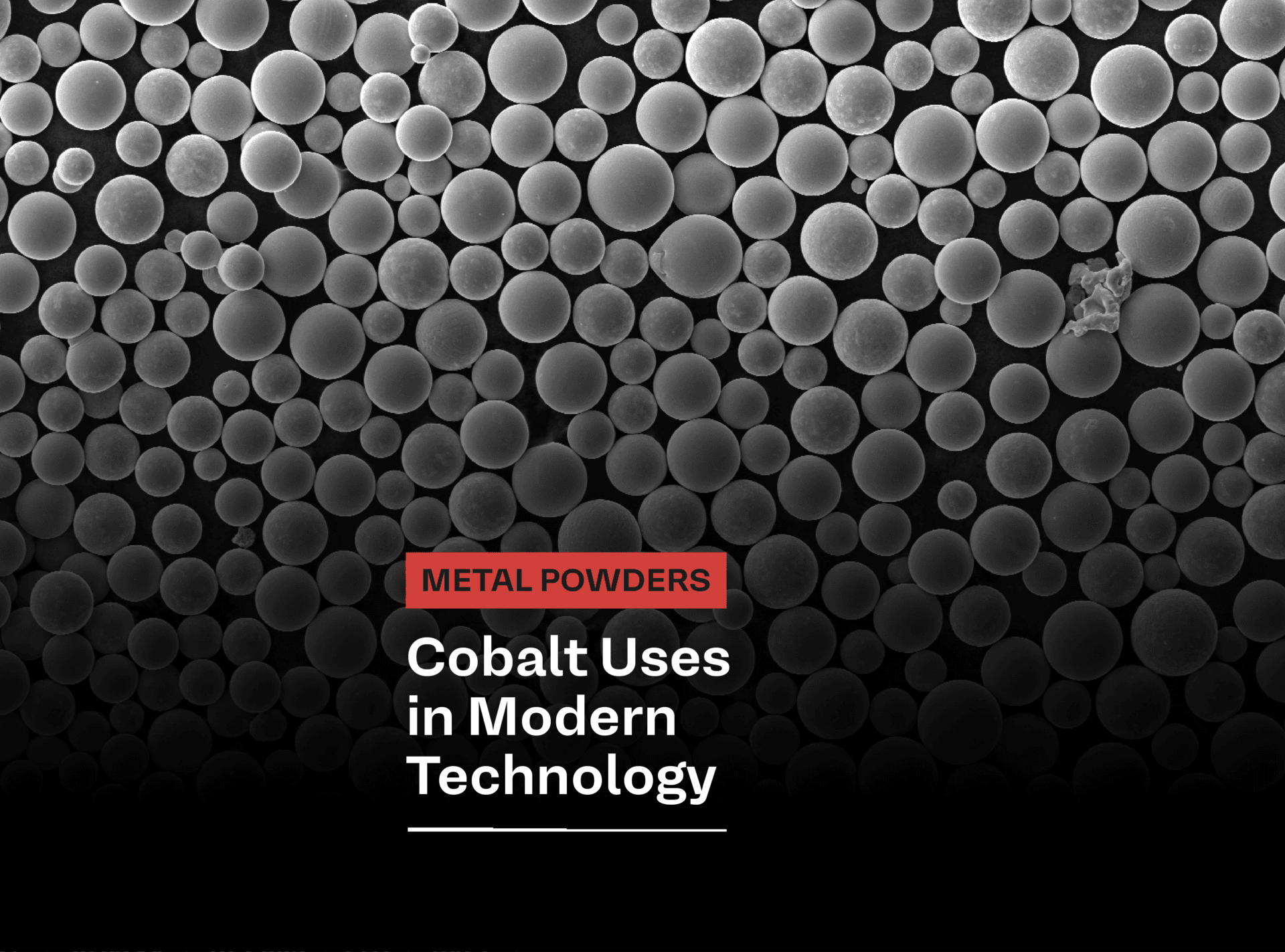
Cobalt and cobalt-based alloy powders are used in processes such as laser powder bed fusion and directed energy deposition. These technologies require strict control over powder characteristics.
The most important parameters include:
- particle size distribution
- particle shape and sphericity
- chemical purity
- flowability
In this context, cobalt powder enables the production of complex geometries and high-performance components. It also supports efficient material usage, which is important for high-value alloys.
Cobalt-based powders are particularly relevant for cobalt-chromium alloys used in medical implants, as well as for wear-resistant and high-temperature applications. Additive manufacturing allows these materials to be used in more optimized and functionally efficient designs.
Cobalt common uses compared with advanced applications
The phrase cobalt uses in everyday life typically refers to batteries, pigments and consumer products. However, from a technical perspective, the most demanding applications are found in advanced engineering.
These include superalloys, catalytic systems and powder-based manufacturing processes. In these areas, material performance is critical, and even small changes in composition or processing can have significant effects.
Understanding cobalt therefore requires looking beyond common uses and considering its role in high-performance systems.
Why cobalt is difficult to replace
Despite efforts to reduce its use, cobalt remains difficult to substitute in many applications.
This is because it provides a combination of properties that are rarely found together:
- thermal stability
- mechanical strength
- resistance to corrosion and oxidation
- structural stabilization in alloys and compounds
In batteries, reducing cobalt content often leads to trade-offs in safety or durability. In high-temperature systems, alternative materials may not provide the same level of reliability.
The role of cobalt alloys
In practice, cobalt is most often used in alloyed form. Cobalt-chromium alloys are widely used in medical and wear-resistant applications, while cobalt-based superalloys are essential in aerospace and energy systems.
Alloying allows precise control over material properties, including strength, corrosion resistance and thermal behavior. In powder-based manufacturing, alloy design must also consider processing characteristics such as melting and solidification.
This makes cobalt alloys a key focus area in advanced materials engineering.
Cobalt in the context of AMAZEMET
Not all uses of cobalt are directly related to powder technologies. Applications such as battery chemistry or pigments extend beyond the scope of advanced manufacturing solutions.
However, cobalt becomes particularly relevant in areas such as:
- metal powders for additive manufacturing
- alloy development and optimization
- high-performance materials processing
AMAZEMET focuses on these advanced material domains, where control over powder characteristics and processing conditions is essential.
For research teams and industrial partners working with demanding metallic systems, properly engineered cobalt powders can play a critical role in achieving consistent and high-performance results.

Conclusion
Cobalt remains a key material in modern technology, with applications ranging from energy storage to high-temperature alloys and advanced manufacturing. Its importance comes from a combination of properties that enable reliable performance in demanding conditions.
While batteries dominate public attention, other areas such as superalloys and powder-based technologies are equally important from an engineering perspective. As manufacturing continues to evolve, especially with the growth of additive technologies, the role of cobalt, particularly in powder form, is expected to become even more significant.
Share this content!