Additive Manufacturing Workflow: Software & Management Guide
Powder-based metal AM is rarely “just print and go.” Most cost overruns and quality escapes come from powder variability, poor powder genealogy tracking, and post-processing decisions made too late. That’s true for powder bed fusion—and it becomes even more visible in powder DED technologies, where powder feed stability and contamination control can make or break consistency.
Below is a powder-first additive manufacturing workflow focused on metal powders, detailing how to specify and source them (including custom atomization when necessary), control reuse/recycling, and integrate powder data with heat treatment and HIP steps to ensure the entire process is repeatable—not just the printer settings.
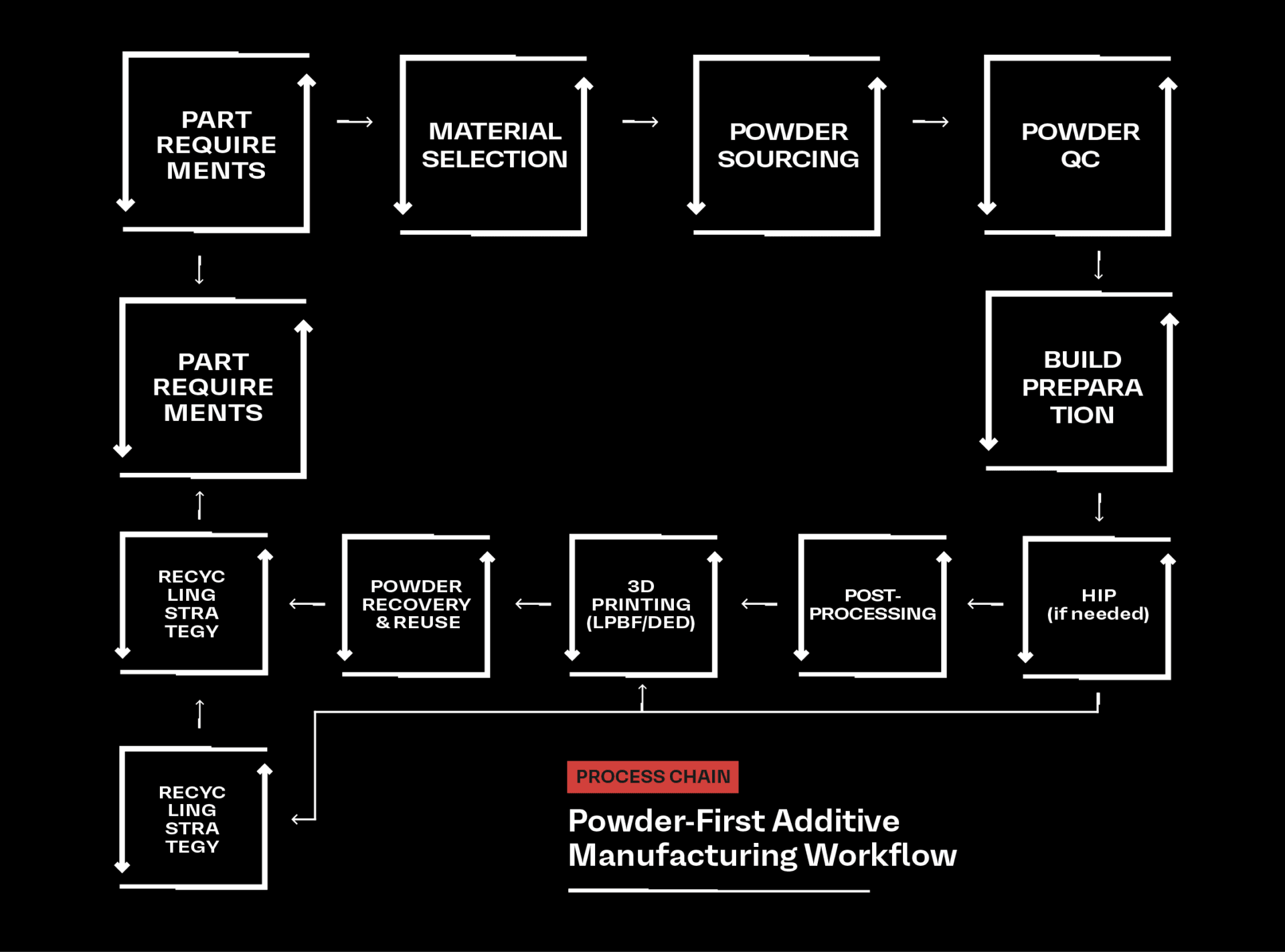
Additive manufacturing workflow: powder-first process chain for metal AM
A production-grade additive manufacturing workflow for metal powders usually includes these stages:
- Part requirements & acceptance criteria (strength, fatigue, corrosion, certification, NDT expectations)
- Material selection & powder specification (chemistry + PSD + morphology + cleanliness)
- Powder sourcing (commercial supply or custom atomization when required)
- Incoming powder QC (verify what you received, not only the CoA)
- Powder handling & safety (storage, humidity, cross-contamination prevention)
- Build preparation + traceability plan (define what data will be captured)
- Printing (LPBF/EBM) or powder DED (process monitoring and feed validation)
- Powder recovery + reuse/refresh rules (and DED overspray handling)
- Post-processing (stress relief/heat treatment, machining, surface finishing)
- HIP (when justified) (fatigue-critical or porosity-sensitive applications)
- Final inspection + documentation pack
- Recycling strategy (when reuse is no longer safe/economic)
Key idea: powder is not a static input. It ages through thermal exposure, handling, and reuse—so the workflow must treat powder as a controlled variable.
Material selection: the powder spec is the real “starting point”
In powder-based metal AM (and especially in powder DED technologies), the same nominal alloy can behave very differently depending on powder characteristics.
A practical powder spec should define and control:
- Chemical composition (including tight limits for O/N/H for reactive alloys)
- Particle size distribution (PSD) (not just “average size”)
- Morphology (sphericity, satellites, agglomerates, internal porosity)
- Flowability & spreadability / feedability
- Cleanliness (oxides, inclusions, cross-contamination)
- Moisture control (storage and exposure history)
Match PSD to the AM process (LPBF vs EBM vs powder DED)
A good workflow explicitly links PSD targets to the printing method:
- LPBF / SLM: commonly uses finer powder fractions (often around ~15–63 μm as a starting point)
- EBM: typically runs coarser powder than LPBF (often ~45–106 μm range
- Powder DED: often runs coarser powders than LPBF, often in the 45 – 150 micron range, because the powder must feed reliably through lines/nozzles and resist clogging; PSD windows vary widely by head design and layer strategy
Instead of arguing about one “correct” PSD, define a process-specific acceptance window and confirm it with:
- stable powder feed (DED) or stable powder spreading (PBF),
- consistent melt pool behavior,
- repeatable density and mechanical properties.
Flowability: set a measurable target (and document the method)
Flowability numbers only matter if the measurement method is consistent following ISO 4490 or ASTM B213. Still, it’s helpful to define a practical target window as a go/no-go indicator.
A commonly used internal acceptance window for many AM teams is a flow rate around ~9–12 g/s (measured as mass-per-time in a Hall-type setup),
If your operation uses “seconds per 50 g” instead, convert and document it so everyone speaks the same language.
Powder sourcing: commercial powder vs custom atomization (don’t force-fit)
If the alloy you need is not commercially available in the required PSD/quality—or you need designed chemistry—the workflow should include a formal decision point:
When to commission atomization
You should consider custom powder manufacturing when:
- You need tailored chemical composition (microalloying, modified chemistry, research alloys)
- You need small, repeatable lots for R&D or qualification builds
- Commercial powder exists, but PSD/morphology doesn’t match your process window
- You need tighter control of batch-to-batch variability than the commodity market provides
This is where AMAZEMET’s atomization services can fit naturally in the workflow: enabling powder supply with projected (designed) chemical composition when off-the-shelf options won’t meet the requirement.
If you need a short explainer to align internal stakeholders on terminology, this resource can help: what is additive manufacturing?
Powder prototyping & iteration: adjust PSD and behavior without turning the blog into a datasheet
In R&D and pre-production, time-to-powder often limits time-to-part. If you can’t iterate powder quickly, you end up iterating printer parameters forever—often masking root causes.
Tools like AMAZEMET rePOWDER are relevant here as an ultrasonic atomization-based platform for alloy-to-powder iteration, where the goal is speeding up materials development and powder trials.
From a workflow perspective, what matters is the principle:
- PSD and powder behavior can be tuned by adjusting atomization parameters such as frequency and amplitude (and related energy input settings).
- The workflow should treat PSD “tuning” as a controlled experiment: change one knob, measure PSD/flowability/morphology, then validate on build outcomes.
This keeps the article focused on workflow decisions—without turning rePOWDER into a technical spec sheet.
Powder handling & safety: contamination control is a quality system, not a checklist
Powder handling is where good powder becomes unpredictable powder—especially in facilities that run multiple alloys or multiple processes (LPBF + DED).
Three failure modes to design out
- Oxidation and chemistry drift (risk increases with reactive materials and poor storage discipline)
- Cross-contamination (shared tools, shared sieves, shared recovery stations)
- Fines & dust hazards (EHS risk and also a quality risk)
Practical controls that prevent rework
- Use dedicated, labeled tools per alloy family (scoops, sieves, containers)
- Add a powder quarantine rule: any powder with uncertain history is “hold” until retested
- Standardize storage (sealed containers, dry environment, exposure-time logging)
- For DED, control and clean:
- powder feed lines,
- nozzle interfaces,
- capture systems for overspray (and define whether it’s reusable at all)
Powder DED technologies: workflow differences you should plan for
Powder DED is often chosen for repair, near-net builds, larger components, or adding features to existing parts. But powder-centric workflow risks are different than in powder bed fusion.
What changes in DED
- Powder feed stability becomes a primary process variable (mass flow drift = geometry drift)
- Catchment efficiency (how much powder ends up in the melt pool) impacts both cost and “powder history”
- Overspray can introduce contamination and oxidation—especially in less controlled atmospheres
- Powder DED typically benefits from:
- feeder calibration routines,
- monitoring powder mass consumption vs expected,
- and strict rules for any reclaimed powder
DED-specific best practices (high ROI)
- Verify feeder output with periodic gravimetric checks (planned intervals, documented results)
- Treat “powder in the system” like a lot-controlled material (lines and hoppers included)
- Define a clear policy: Is overspray reusable, refreshable, or scrap?
If it’s reusable, require retesting (PSD + contamination checks) before it re-enters production.
Digital workflow additive manufacturing: what to track if you want repeatability
A digital workflow additive manufacturing program should capture the variables that actually change build outcomes—especially powder genealogy and reuse history.
Minimum powder data model (practical, not academic):
- Powder lot ID, supplier or custom atomization batch ID
- PSD test results (date + method)
- Flowability test result (date + method + acceptance window)
- Chemistry checks where relevant (O/N/H for reactive alloys)
- Storage exposure history and container ID
- Reuse count / reuse cycle ID
- Sieve mesh used and sieving date
- Machine/build linkage (which builds used which powder lots)
If your system can’t link these reliably, powder variability will keep sneaking into “mystery build failures.”
Additive manufacturing workflow software: powder genealogy and post-process traceability
When people search for additive manufacturing workflow software, they often think about job scheduling and file control. For powder-based metal AM, the value is bigger:
- linking powder lot → build → part → heat treatment → HIP → inspection results,
- preventing “spreadsheet powder genealogy,”
- and enforcing retest gates automatically.
A strong software setup should support:
- attachments (PSD charts, SEM images, furnace logs),
- nonconformance workflows (powder anomaly → containment → disposition),
- and structured “reuse rules” rather than tribal knowledge.
Additive manufacturing workflow management software: governance for reuse, refresh, recycle
Additive manufacturing workflow management software should do more than store records—it should prevent bad decisions.
Recommended governance rules to implement:
- Reuse limits (e.g., max reuse cycles before retest)
- Refresh rules (define blend ratios and require documentation)
- Recycle triggers (when powder becomes off-spec)
- “Stop-the-line” rules for:
- unexpected flowability drift,
- PSD shifts,
- contamination events,
- or unknown powder history
For organizations running both PBF and powder DED, governance matters even more because “recovered powder” can mean very different things depending on the process.
Post-processing in the additive manufacturing workflow: heat treatment and HIP (where decisions become permanent)
Post-processing is where you turn “as-built” into “engineered.” For many alloys and applications, mechanical performance and distortion control are decided here.
Heat treatment: residual stress control and microstructure tuning (inFURNER context)
High-vacuum heat treatment is commonly used to:
- relieve residual stresses,
- reduce distortion risk,
- and stabilize properties before machining and inspection.
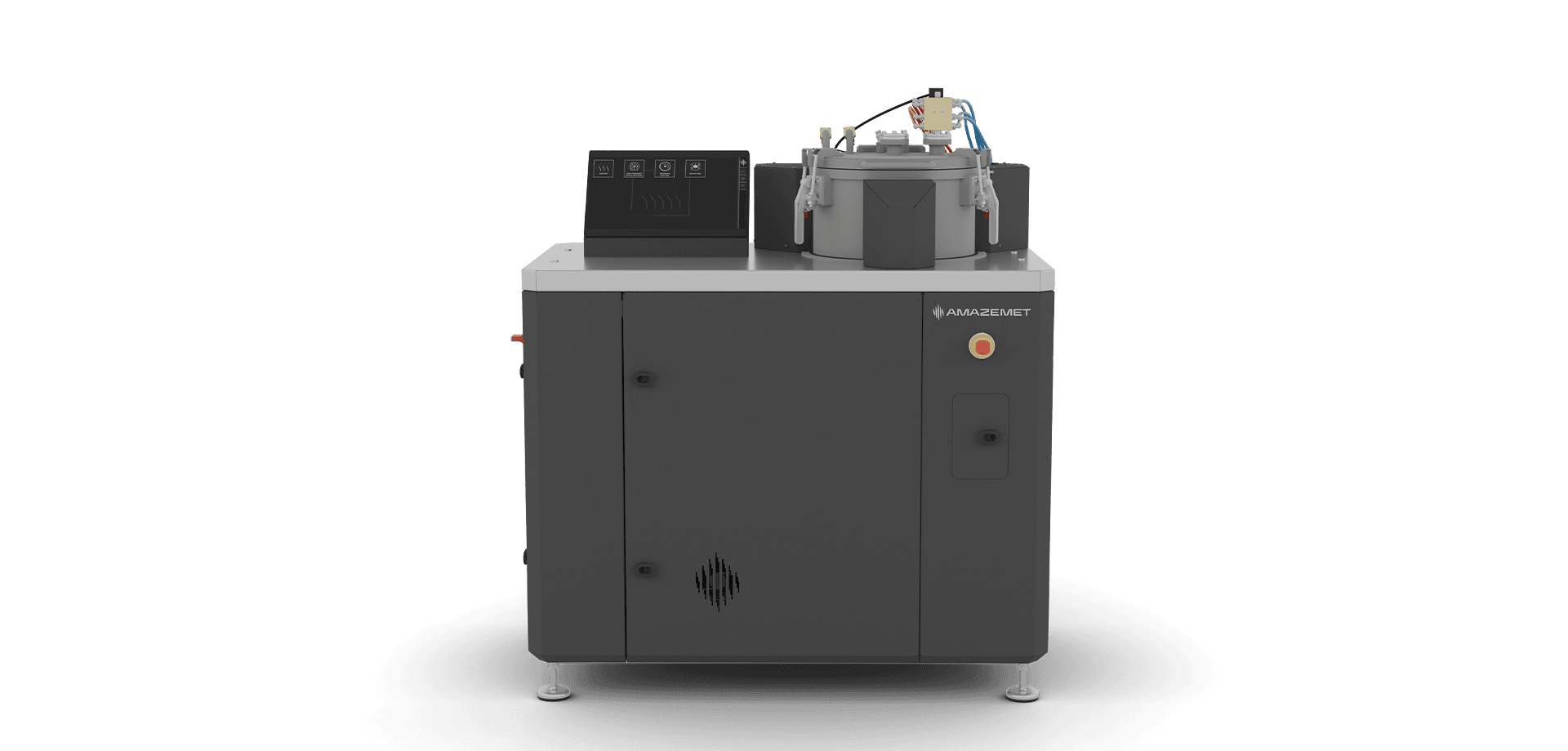
This is where AMAZEMET inFURNER fits as a workflow tool: supporting controlled vacuum heat treatment for AM parts and enabling documented, repeatable thermal cycles (important when you’re building a qualification pathway, not just making one-off parts).
HIP: when it’s worth it
HIP is typically justified when:
- fatigue performance is critical,
- internal porosity is unacceptable,
- or you want to reduce defect sensitivity and variability.
In literature and industry practice, HIP is often described as one of the most effective routes to drastically reduce internal porosity—especially for demanding applications. The workflow decision is to apply HIP where it buys real reliability, not as a default step for every part.
AMAZEMET’s broader OEM/service context includes supporting workflows that can involve HIP for printed parts—so it can be positioned as part of an end-to-end route when the application truly requires it.
Reuse vs recycling: the “end-of-life plan” for powders (Powder2Powder context)
Even with strong reuse discipline, powders eventually drift out of spec:
- PSD shifts (too many fines or too many oversized particles),
- contamination and oxides increase,
- flowability degrades,
- spatter/agglomerates accumulate.
At that point, reuse becomes a hidden risk—and a hidden cost.
Where Powder2Powder fits
A mature workflow includes a recycling stage for powders that can’t be safely reused or refreshed.
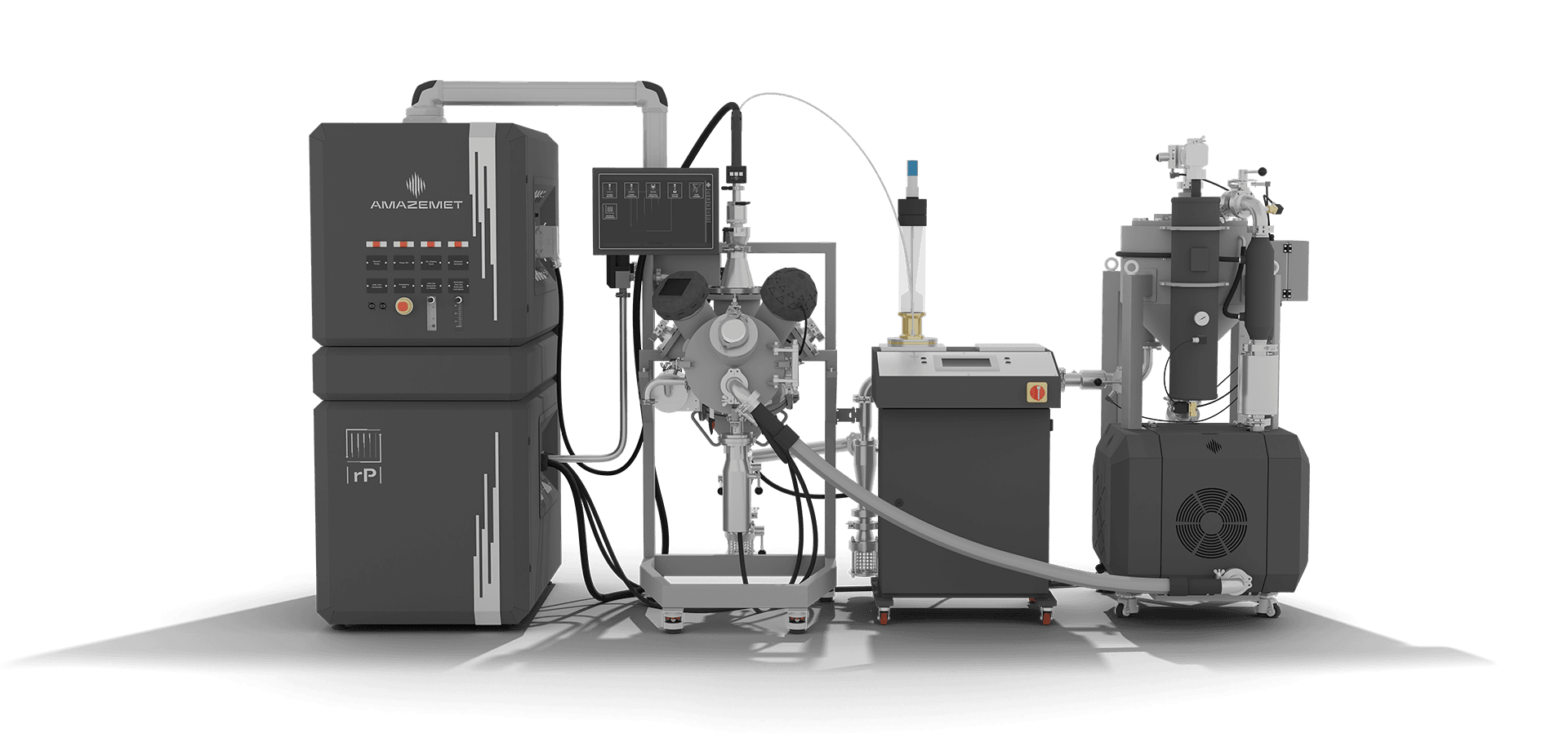
AMAZEMET’s Powder2Powder concept is relevant here: a route designed for reprocessing used powder back into AM-suitable powder, supporting a more closed-loop approach (particularly valuable when powder cost, availability, or sustainability targets matter).
Learn more here Powder2Powder.
Where AMAZEMET fits in a powder-centric metal additive manufacturing workflow
In metal additive manufacturing, your competitive advantage often comes from controlling feedstock quality and post-processing repeatability—not from chasing printer parameter tweaks forever.
If your workflow challenges are powder-specific, AMAZEMET fits most naturally at these stages:
- Powder sourcing when commercial options fail: custom atomization with designed chemical composition
- Powder iteration during R&D: faster alloy-to-powder learning loops (rePOWDER context, without turning your process into a hardware project)
- Heat treatment of printed parts: controlled vacuum heat treatment (inFURNER context) as part of a repeatable qualification route
- HIP pathway support: when your part requirements justify the cost and complexity
- Powder reuse/recycling strategy: closed-loop thinking and powder reprocessing concepts (Powder2Powder)
If you’re building a repeatable powder-based workflow—LPBF, EBM, or powder DED technologies—and you need help with tailored powder chemistry, custom atomization, heat treatment, or powder reuse/recycling strategy, focus your next discussion on the workflow stage that currently creates the most variability (powder spec, sourcing, reuse rules, or post-processing).
Share this content!